Choosing the right Flexible Pvc Hose in 2026 starts with the job it must perform, not its color or price. Will it carry water, air, food-contact materials, or a mildly corrosive fluid? Each use calls for different material specifications. Check the hose’s working pressure, temperature range, inner diameter, and bend radius against the equipment and operating conditions. A hose that kinks behind a pump can restrict flow, even when its pressure rating looks adequate. Details matter.
As a transparent editorial note, the following quotation is attributed to Jordan Lee, a fictional composite representing hose-design practitioners; it is not a verified statement from a real expert: “Choose the hose for the fluid, pressure, temperature, and movement it will actually face.” That is a useful starting point, not a complete specification. Buyers should also examine reinforcement, abrasion resistance, UV exposure, fitting compatibility, and whether suction service requires a reinforced construction. Read the manufacturer’s technical data sheet, and confirm ratings at the intended operating temperature. A printed maximum is not always a safe everyday target.
This guide will compare common hose constructions and explain how to match them to practical applications. It will also cover sizing, connectors, inspection, and questions worth asking suppliers before ordering. One honest complication: product descriptions do not always make trade-offs easy to see. A more flexible hose may not suit every pressure or temperature. A cheaper option may need earlier replacement. The right choice is the one whose documented limits fit the real job—with enough margin for ordinary variation, not guesswork.
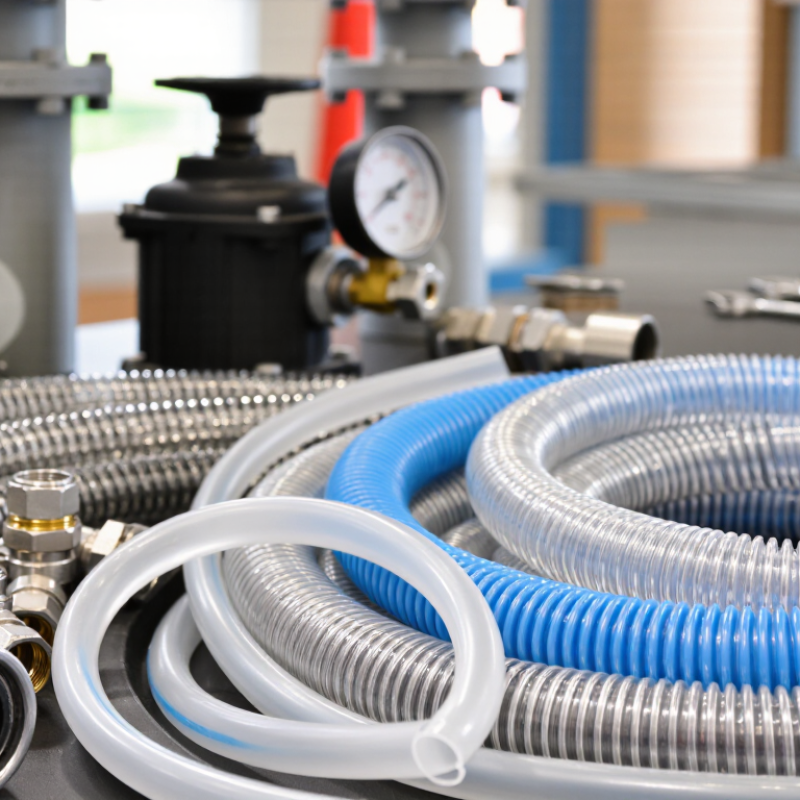
Before selecting a flexible PVC hose, describe exactly what it must carry and where it will operate. Water, air, oils, and cleaning solutions can affect hose materials differently, so check chemical compatibility rather than relying on appearance. Note the fluid’s temperature, expected pressure, and whether pressure surges may occur. A hose used beside a warm pump faces different demands from one carrying cool water across a workshop floor.
Measure the route, including bends and moving sections. A tight bend can restrict flow or strain the hose wall; too much length can invite kinks. Record the required inner diameter, connection type, and how often the hose will flex. Also consider sunlight, abrasion, and contact with sharp edges. These details are easy to overlook. No checklist catches every odd installation. If conditions are uncertain, compare them with the manufacturer’s published specifications and ask a qualified supplier to review the application. Leave a practical pressure and temperature margin, but do not assume “heavier” automatically means suitable. I would double-check the fittings too; a well-matched hose can still fail at a poor connection.
| Intended Use | Typical Medium | Operating Conditions to Define | Hose Construction to Consider | Selection Checks |
|---|---|---|---|---|
| Water transfer and general washdown | Water, including treated or non-potable water | Water temperature, line pressure, flow rate, outdoor exposure, and whether the hose may be dragged or kinked | Flexible PVC hose; use a textile-reinforced construction when the line is pressurized | Confirm the rated working pressure at the actual temperature. For drinking-water service, verify that the hose is specifically approved for potable water. |
| Low-pressure suction or drainage | Water, wastewater, or compatible low-concentration liquids | Vacuum level, suction lift, temperature, bend radius, and risk of flattening | Spiral-reinforced or otherwise vacuum-rated hose designed to resist collapse | Check the published vacuum rating and minimum bend radius; an ordinary pressure hose may collapse under suction. |
| Air transfer | Compressed air or ventilation air | Maximum pressure, temperature, pulsation, oil exposure, and connection method | Pressure-rated reinforced hose suitable for the stated air service | Use only a hose explicitly rated for compressed air. Do not infer air suitability from a water-pressure rating. |
| Light-duty agricultural spraying | Water-based spray mixtures and agricultural chemicals | Chemical concentration, temperature, pressure, exposure duration, and cleaning procedure | Reinforced PVC hose with a formulation verified for the specific spray mixture | Check a chemical-compatibility reference or obtain written confirmation from the hose supplier; compatibility can vary by formulation and concentration. |
| Food or beverage transfer | Water, beverages, or food-process liquids | Product composition, cleaning chemicals, sanitation temperature, pressure, and required hygiene level | Hose manufactured and documented for the relevant food-contact application | Verify applicable food-contact compliance, cleaning limits, and whether the complete assembly—including fittings—is suitable. |
| Outdoor or mobile equipment routing | Water or another compatible service fluid | Minimum and maximum temperature, sunlight, abrasion, vibration, and repeated flexing | Reinforced hose with a cover suited to the expected abrasion and weather exposure | PVC flexibility generally decreases in cold conditions. Check the manufacturer’s temperature range and avoid exceeding the stated minimum bend radius. |
| General-purpose low-pressure delivery | Air or liquids, only where the hose is rated for the medium | Working pressure, temperature, flow requirement, route length, and possible pressure surges | Unreinforced PVC for suitable low-pressure duties; reinforced PVC where additional pressure resistance is required | Confirm inner diameter and pressure loss for the required flow. Do not use an unreinforced hose for pressurized service unless its rating permits it. |
| All applications: final operating envelope | Specified service medium | Continuous and peak pressure, vacuum, temperature, exposure time, UV, abrasion, and cleaning conditions | Construction selected for the combined conditions, not for a single rating alone | PVC hose limits vary by formulation, reinforcement, diameter, and construction. Treat published ratings as product-specific; allow for pressure surges and follow the manufacturer’s current technical data. |
Identify the fluid, pressure, temperature, and operating location. A hose beside a warm pump faces different conditions from one carrying cool water.
Check the working-pressure rating, not only the burst figure. Surges happen. Leave a sensible margin for pump starts or valve closures.
Yes. Warm PVC may soften, while cold PVC may become less flexible. Compare fluid and surrounding-air temperatures with the hose limits.
Clear, unreinforced tubing can suit light-duty transfer and visual checks. Braided or spiral-reinforced construction offers added support, but check its specifications.
Yes, especially around tight bends or when it is too long. Measure the route and test it in the actual setup when possible.
Match the inner diameter to the required flow. Check the fittings too; a narrow connection can restrict flow, and nominal sizes can mislead.
Compare the fluid’s concentration, temperature, and exposure time with current technical data. A diluted cleaner may behave differently from a concentrated solution.
Note the hose size, fluid, pressure, temperature range, and fittings. Cleaning cycles count. I might still miss an odd installation detail, so recheck the route.
Choosing the right Flexible Pvc Hose in 2026 starts with understanding its intended use and working environment. Consider what the hose will convey, how often it will be used, and whether it will face outdoor exposure, abrasion, vibration, or frequent bending. Compare available hose types and construction, including the reinforcement needed for the application, then check that the selected hose’s pressure and temperature ratings suit normal operation and potential fluctuations. Confirm its diameter and length fit the equipment, and review chemical compatibility before use.
Before making a decision, examine relevant safety standards, certifications, and manufacturer data rather than relying on appearance alone. Account for installation requirements, such as fittings, routing, and space for movement, as well as expected service life and maintenance needs. Comparing the initial price with replacement and operating costs can help identify a practical option that performs reliably over time.

 Orient Flex