Global buyers comparing China’s Plastic Hose manufacturers need more than a low quotation. The right supplier must match the hose to its real working conditions: fluid type, pressure, temperature, bend radius, and exposure to sunlight or abrasion. A clear technical drawing and a small sample can reveal problems that a polished catalogue may not show. Details matter.
Quality expert W. Edwards Deming is often credited with the reminder, “Quality is everyone’s responsibility.” For hose sourcing, that idea reaches from compound selection to extrusion, reinforcement, inspection, and packing. Buyers should ask how a manufacturer controls dimensions, checks pressure performance, traces batches, and handles nonconforming products. Requesting test records is useful, but buyers should also confirm what each test measures and whether it reflects their actual application.
Price still matters. So do lead times, communication, packaging, and the supplier’s ability to maintain consistent production. A factory visit or independent audit may provide useful evidence, but neither guarantees that every shipment will be flawless. No shortlist is final until samples and documents have been reviewed against the intended use. Even then, some uncertainty remains. This guide looks at how global buyers can assess Chinese manufacturers carefully, compare practical strengths, and ask better questions before placing an order.
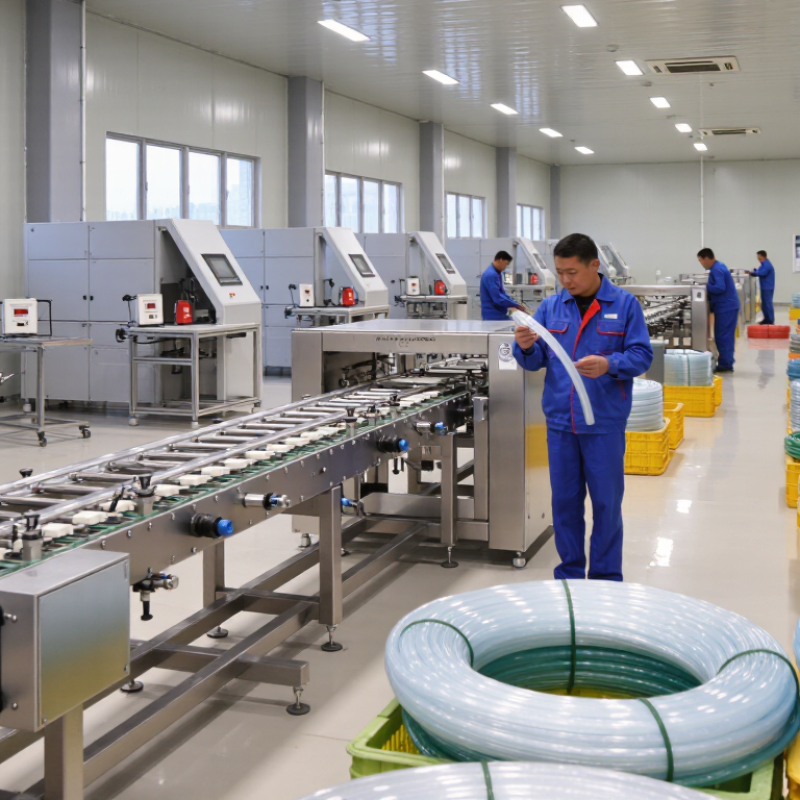
Plastic hose manufacturers in China produce tubing for water delivery, air lines, drainage, irrigation, and selected industrial uses. Common materials include PVC, polyurethane, polyethylene, and nylon. Each behaves differently. PVC is often used for clear braided hose, garden hose, and flexible water lines. Polyurethane can suit applications needing abrasion resistance, while polyethylene tubing is common in low-pressure fluid systems.
Products vary in structure as well as material. A clear PVC hose may have a visible polyester braid between its inner and outer walls. Suction hose can use a rigid spiral to resist collapse. Lay-flat hose is designed to flatten for storage and expand during use. Details matter. Inner diameter, wall thickness, reinforcement, temperature range, and working pressure all affect performance. A hose that looks sturdy on a sample may still kink when routed around a tight corner.
Manufacturers may also offer custom lengths, colors, fittings, and packaging, depending on their equipment and production runs. Buyers should request a specification sheet and confirm how pressure ratings were measured. Material compatibility needs checking, too; “chemical resistant” is not a universal guarantee. Not every catalog description is equally precise. Comparing a sample against the intended fluid, operating conditions, and installation path can reveal gaps before a large order is placed.
| Plastic Hose Product | Common Materials and Construction | Typical Applications | Key Details for Buyers to Verify |
|---|---|---|---|
| PVC braided hose | Flexible PVC layers with a textile reinforcement braid, commonly polyester. | General water transfer, compressed-air lines and light-duty fluid handling. | Working pressure at the intended temperature, hose dimensions, bend radius and compatibility with the conveyed fluid. Pressure ratings vary by construction. |
| PVC suction and delivery hose | Flexible PVC wall supported by a rigid PVC helix; some designs include additional reinforcement. | Water suction and discharge, drainage and certain material-transfer tasks. | Confirm whether the hose is suitable for suction, its vacuum rating, wall construction, abrasion resistance and chemical compatibility. |
| PVC lay-flat hose | Flexible PVC with textile reinforcement, designed to flatten for storage and transport. | Water discharge, irrigation, drainage and temporary pumping lines. | Check operating pressure, coupling requirements, temperature limits and whether the intended use is discharge only; lay-flat designs are not automatically suitable for suction. |
| PVC garden hose | Typically a flexible, multi-layer PVC construction; reinforcement may be included depending on the design. | Gardening, landscaping and general outdoor water use. | Review kink resistance, UV and weathering performance, connector compatibility and any requirements for drinking-water contact. |
| Polyurethane (PU) hose or tubing | Flexible polyurethane, available in different formulations and hardness levels. | Pneumatic equipment, flexible tubing and selected abrasive-material handling applications. | Confirm the exact PU formulation, operating pressure, temperature range, abrasion needs and compatibility with oils or other conveyed media. |
| Polyethylene (PE) tubing | Flexible or semi-rigid tubing made from polyethylene grades such as LDPE, LLDPE or HDPE. | Irrigation, water distribution and low-pressure fluid or air lines, depending on the specification. | Check grade, outside diameter and wall thickness, pressure rating, UV exposure conditions and potable-water approval where required. |
| Unreinforced PVC tubing | Single-wall flexible PVC tubing, often supplied in clear or colored versions. | Low-pressure water transfer, equipment connections and general-purpose tubing uses. | Verify pressure and temperature limits, wall thickness, clarity requirements and resistance to the specific fluid. Unreinforced tubing is not equivalent to pressure-rated braided hose. |
| Flexible plastic ducting hose | Often made from PVC or polyurethane, with a helix or other support structure to help retain its shape. | Air movement, ventilation, dust extraction or light material conveyance, depending on construction. | Confirm suitability for the material being conveyed, abrasion and static-control requirements, temperature limits and the specified bend radius. |
Buyer note: These are common plastic-hose product categories, not a guarantee that every manufacturer produces every type. Request a product specification sheet and test documentation for the exact hose construction. Regulatory and food-contact requirements depend on the destination market and intended use.
PVC is lightweight and economical for garden watering, drainage, and general transfer. Polyurethane suits repeated bending and abrasion. Polyethylene, silicone, and reinforced hoses serve other specific needs.
No. Clear walls can reveal trapped air or visible contamination, but they do not confirm fluid compatibility. Check the hose specifications.
It handles repeated bending and abrasion well, making it suitable for pneumatic tools, moving equipment, and workshop extraction. Tight bends still deserve attention.
Confirm compatibility with the exact fluid and operating conditions. A material name alone is not enough.
They stay flexible across a broad temperature range. Food-processing and medical equipment may use them when the specified grade is appropriate.
Check working pressure, temperature range, bend radius, and fluid compatibility. A tight corner can kink the hose and restrict flow. Small details matter.
Request the resin grade, inner diameter, working pressure, reinforcement, minimum order quantity, and delivery terms. Compare matching specifications, then inspect a sample. Test methods can differ.
China offers broad material choices and production capacity, but scale does not guarantee consistent quality. Ask for specifications, tolerances, and recent test records.
Confirm the HS classification, invoice, packing list, origin-document requirements, and shipping schedule with the supplier and freight forwarder. Allow time for production checks and port handling. Delivery timing can still surprise you.
This guide explains what Chinese manufacturers typically produce, from flexible water and air hoses to reinforced, chemical-resistant, and specialty tubing for industrial, agricultural, construction, and household applications. It outlines how buyers can match hose materials and construction to operating conditions, including pressure, temperature, flexibility, and intended use. The focus is on practical selection rather than promoting individual suppliers.
For global buyers, the guide also describes how to assess a Plastic Hose manufacturer’s production capabilities, quality-control procedures, communication, and ability to meet technical specifications. It highlights the value of reviewing relevant test reports and certifications, confirming product consistency, and requesting samples before placing an order. Finally, it covers sourcing considerations such as quotations, minimum order quantities, packaging, lead times, shipping arrangements, and export documentation, helping buyers compare offers and plan purchases with fewer surprises.

 Orient Flex